
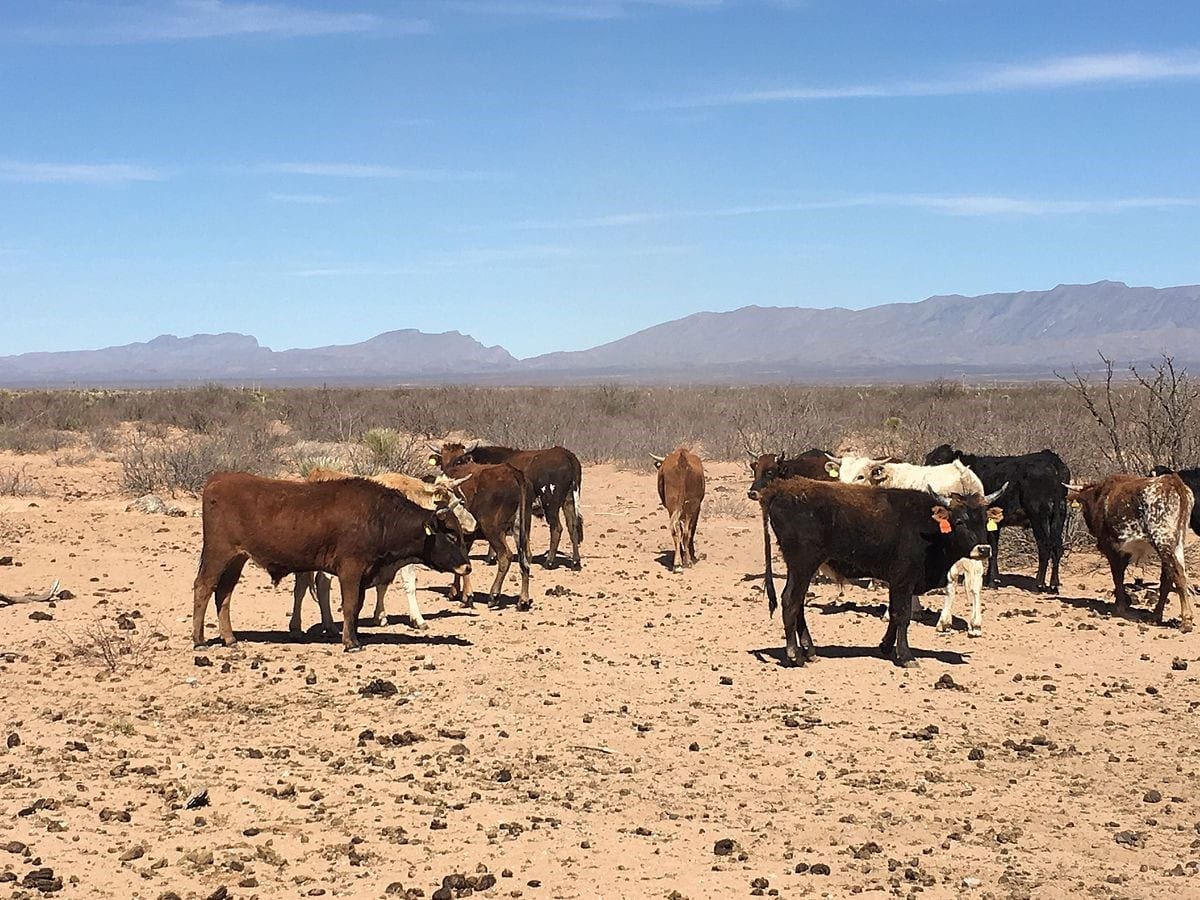
The U.S. Department of Agriculture plans to begin lifting its suspension on Mexican cattle imports by reopening the Douglas, Arizona, port of entry in about 30 days, according to Agriculture Secretary Brooke Rollins in an interview with The Wall Street Journal. Two additional ports in New Mexico are expected to reopen later.
The import ban was imposed more than a year ago to help prevent the spread of the New World screwworm, a flesh-eating livestock pest that has moved north through Central America and has recently been detected in southern Mexico near the U.S. border.
According to the report, USDA believes reopening ports in Arizona and New Mexico presents less risk than resuming imports through Texas because those locations are farther from current screwworm infestations. The suspension of Mexican cattle imports has contributed to tighter U.S. cattle supplies and record-high beef prices over the past year.
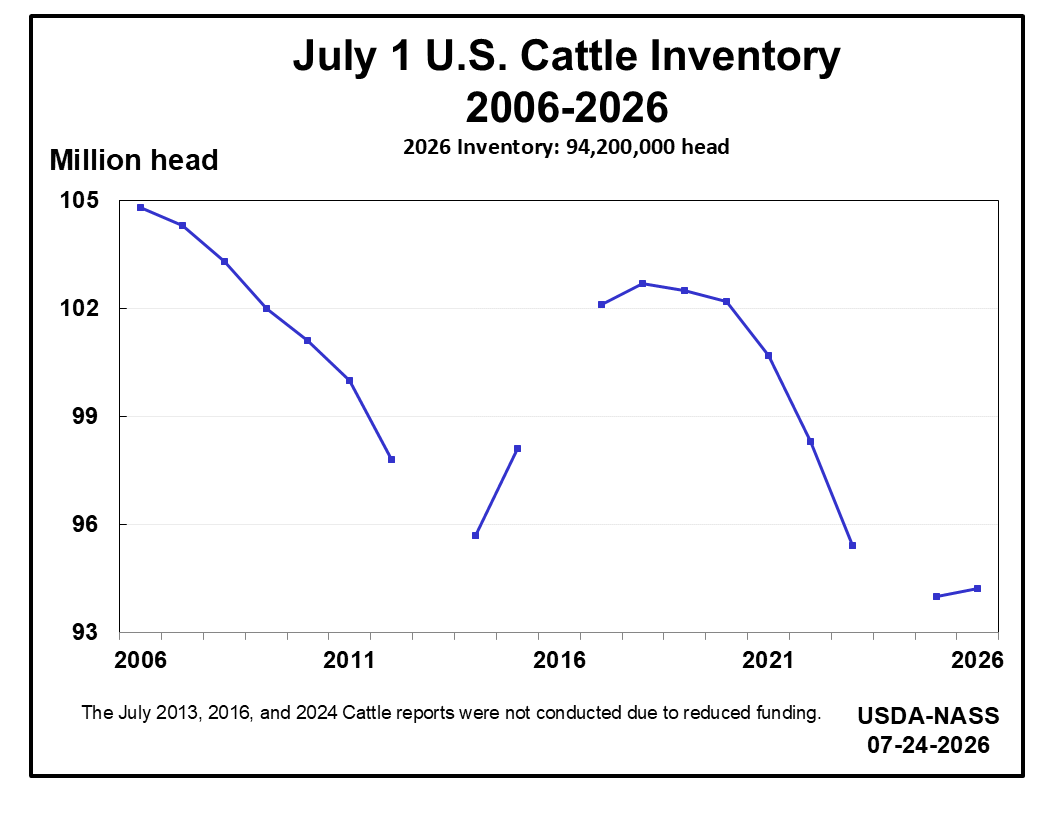
July 1 Cattle Inventory Up Slightly
All cattle and calves in the United States on July 1, 2026 totaled 94.2 million head, slightly above the 94.0 million head on July 1, 2025.
All cows and heifers that have calved totaled 38.1 million head, unchanged from the 38.1 million head on July 1, 2025. Beef cows, at 28.5 million head, are down 1 percent from a year ago. Milk cows, at 9.65 million head, are up 2 percent from previous year.
All heifers 500 pounds and over on July 1, 2026 totaled 14.7 million head, 1 percent above the 14.6 million head on July 1, 2025. Beef replacement heifers, at 3.80 million head, are up 3 percent from a year ago. Milk replacement heifers, at 3.60 million head, are up 3 percent from previous year. Other heifers, at 7.30 million head, are 1 percent below a year earlier.
Steers 500 pounds and over on July 1, 2026 totaled 13.9 million head, up 1 percent from July 1, 2025.
Bulls 500 pounds and over on July 1, 2026 totaled 1.90 million head, unchanged from previous year.
Calves under 500 pounds on July 1, 2026 totaled 25.6 million head, unchanged from a year earlier.
Cattle and calves on feed for the slaughter market in the United States for all feedlots totaled 13.2 million head on July 1, 2026, up 2 percent from previous year. Cattle on feed in feedlots with capacity of 1,000 or more head accounted for 86.1 percent of the total cattle on feed on July 1, 2026, up 1 percent from previous year. The total of calves under 500 pounds and other heifers and steers over 500 pounds (outside of feedlots), at 33.6 million head, is down 1 percent from the 33.8 million head on July 1, 2025.
Calf Crop Down 2 Percent
The 2026 calf crop in the United States is expected to be 32.5 million head, down 2 percent from last year. Calves born during the first half of 2026 are estimated at 23.9 million head, down 2 percent from the first half of 2025. An additional 8.60 million calves are expected to be born during the second half of 2026.
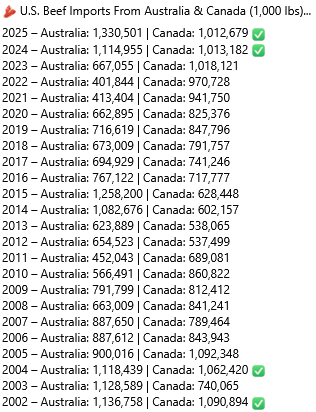
Australia and Canada Each Topped 1 Billion Pounds of U.S. Beef Imports in the Same Year Four Times
The United States has imported more than 1 billion pounds of beef from both Australia and Canada in the same calendar year only four times—2002, 2004, 2024, and 2025. Australia and Canada are also the only two countries to have ever exported more than 1 billion pounds of beef to the United States in a single year. Brazil has never reached that milestone, but based on its current pace, it is on track to surpass 1 billion pounds in 2026, becoming the third country to do so.
🐄 Beef Production and Cattle Slaughter Tick Higher; Weights Down 1 Pound
Beef production for the week ending July 25 totaled 467.3 million pounds, up 0.6% from the previous week but 2.2% below the same week a year ago. Year-to-date beef production stands at 13.73 billion pounds, down 5.8% from 14.57 billion pounds during the same period in 2025.
Federally inspected cattle slaughter totaled 528,000 head for the week, up 0.6% from the previous week but 4.7% below the same week last year. Year-to-date cattle slaughter totals 15.35 million head, down 8.3% from 16.75 million head at this point in 2025.
Average live cattle weights were estimated at 1,447 pounds, down 1 pound from the previous week but 33 pounds heavier than a year ago. Average dressed weights were estimated at 887 pounds, unchanged from the previous week and 22 pounds heavier than the same week last year.
August Feeders Up $4.15 In 2 Days; Boxed Beef Down 4th Straight Day 📉
Choice boxed beef closed Friday at $361.24, down $1.63 from Thursday and $5.57 below last Friday's close. Select boxed beef closed at $346.71, down $2.04 from Thursday. The Choice-Select spread widened to $14.53, with 131 loads of boxed beef reported. Among the primals, the rib increased $3.92 to $564.72, while the plate rose $6.39 to $269.69. The chuck declined $1.84 to $313.72, the round fell $3.94 to $303.60, the loin decreased $2.99 to $438.42, the brisket dropped $5.53 to $329.71, and the flank declined $5.80 to $223.96.
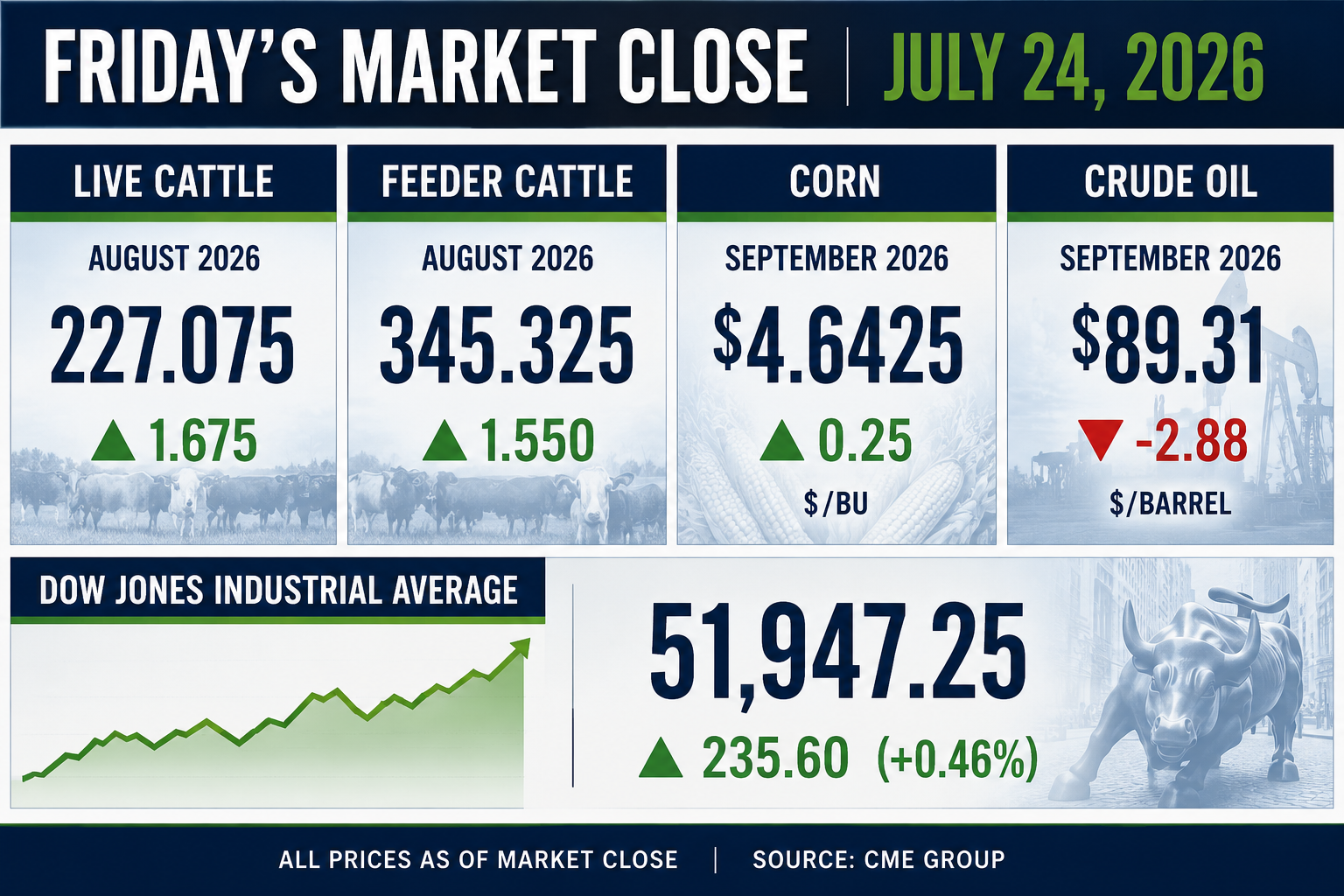
Live cattle futures closed higher on Friday, with the August 2026 contract settling at 227.075, up 1.675. Feeder cattle futures also finished higher, as the August 2026 contract closed at 345.325, up 1.550. In outside markets, September 2026 corn closed at $4.6425/bu, up 0.25 cents. September 2026 crude oil settled at $89.31 per barrel, down $2.88, while the Dow Jones Industrial Average closed at 51,947.25, up 235.60 points (+0.46%).
Nebraska Dressed Sales $15 Lower at $365.00
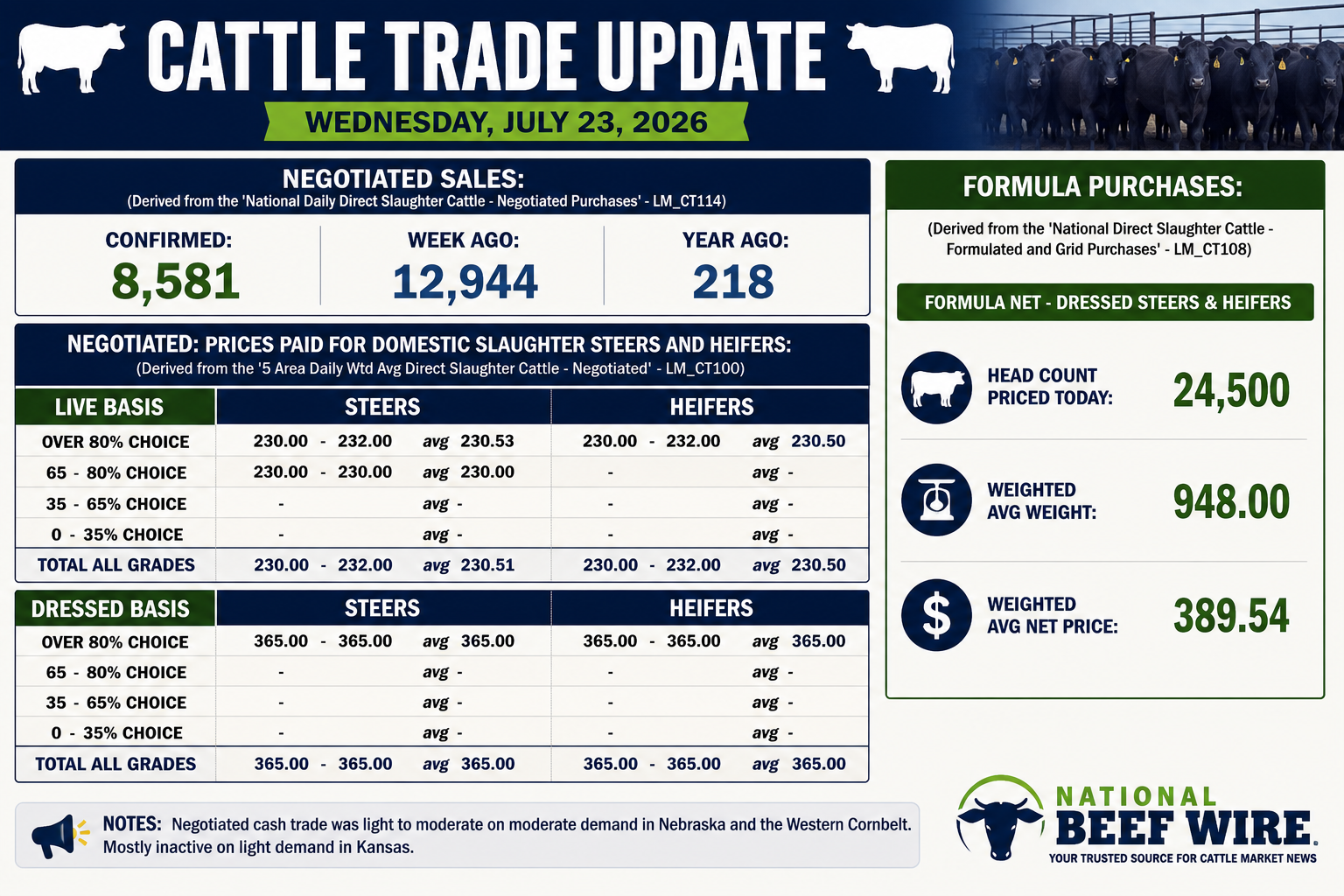
Negotiated cash cattle trade was light to moderate on moderate demand Wednesday in Nebraska and the Western Corn Belt, while activity remained mostly inactive in Kansas. In Nebraska, early dressed sales were reported at $365, $15 lower than last week's established trade. A few live sales were reported from $230-$232, but there were too few to establish a market trend. In the Western Corn Belt, early live sales were reported at $230, $5-$10 lower than last week, with a handful of dressed sales also at $365. Meanwhile, Kansas remained quiet, with no established trade on Wednesday after last week's live market developed mostly at $237-$238. Overall, early cash trade pointed to lower fed cattle prices compared to the previous week.
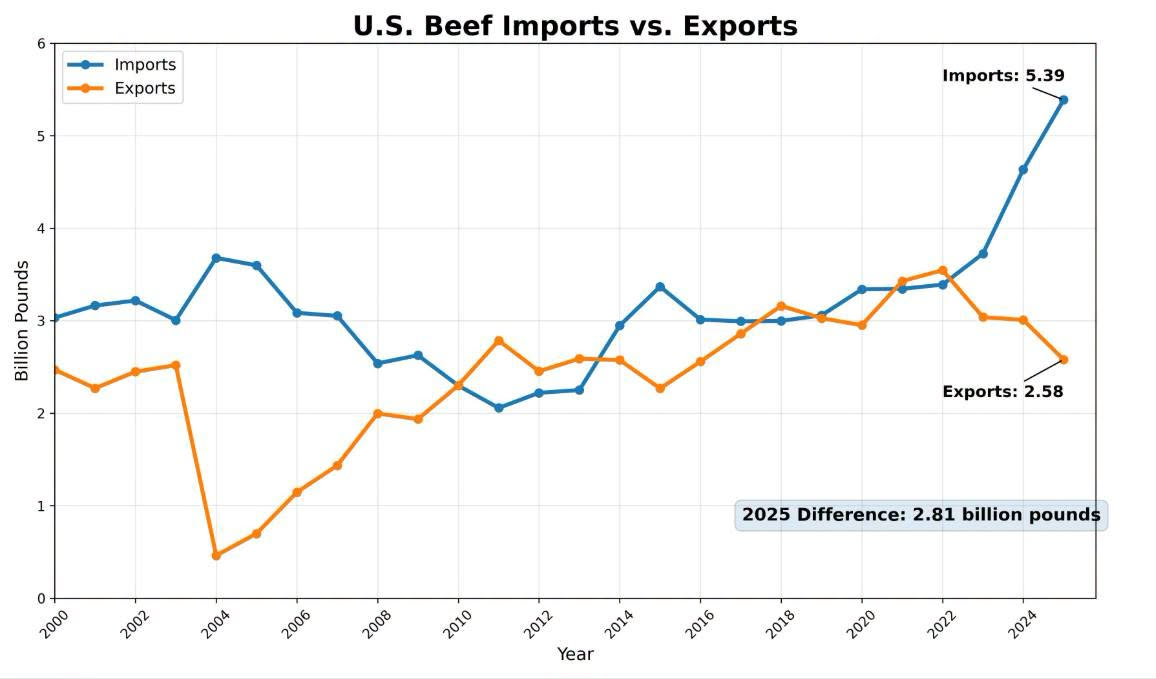
Back to BSE-Era Trade Levels: U.S. Beef Import Surplus Reaches 20-Year High
2025 marked the third consecutive year that U.S. beef imports reached a new record high, climbing to 5.39 billion pounds while exports declined to 2.58 billion pounds. The result was a 2.81 billion-pound import surplus, the widest gap since 2004 and 2005, when U.S. beef exports were largely halted to most international destinations following the discovery of BSE.
While today’s trade imbalance reflects strong domestic demand, tight cattle supplies, and increased reliance on imported lean beef rather than a trade disruption, it underscores how dramatically U.S. beef trade has shifted.
From 2017 through 2022, imports and exports remained near balance, with exports exceeding imports in 2021 and 2022. However, from 2023 through 2025, record imports and declining exports pushed the trade deficit to its widest level in two decades. Over the full 1989–2025 period, exports exceeded imports in only 7 of 37 years.
🥩 Choice Boxed Beef Down 19 of Last 23 Sessions, Off $39.07 Since June 23
Choice boxed beef continued its month-long decline on Friday, closing at $361.24/cwt, down $1.63 from Thursday. The Choice cutout has now fallen $39.07/cwt over the past 23 trading sessions, dropping from $400.31/cwt on June 23 to its lowest level in a month.
The market has posted lower closes in 19 of the last 23 sessions, with the only gain this week occurring on Monday, when the Choice cutout increased $3.29 from Friday's close. Every other trading session this week ended lower, continuing the broader downtrend that has developed since late June.
Friday's close capped another week of declining wholesale beef values, with Choice boxed beef now nearly 10 percent below its June 23 peak.