
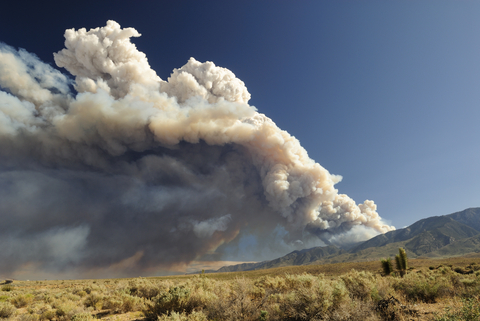
When wildfire smoke fills the air, many people wonder if spraying irrigation water or waiting for rain will help clear the smoke away. It seems like a simple solution. After all, water can wash dust and dirt out of the air. However, scientists have found that rain and water spraying are usually not very effective at removing the tiny particles found in wildfire smoke. The reason has to do with the size of smoke particles.
Wildfire smoke is made up of extremely small particles, many of which fall within the PM2.5 size range. PM2.5 refers to fine particulate matter that is 2.5 micrometers in diameter or smaller and is one of the criteria air pollutants regulated by the EPA. In fact, most wildfire smoke particles are much smaller, only about 0.1 to 0.5 micrometers wide. To put this into perspective, a micrometer is so small that thousands of them could fit across the width of a penny. Because these particles are tiny, they can stay suspended in the air for long periods of time and travel many miles from the source of a fire.
Scientists have studied how water droplets remove particles from the air for decades. When raindrops fall or water is sprayed into the air, they can collect and carry some particles to the ground. This process is called washout. However, not all particles are captured equally well.
There are two main ways water droplets collect particles. The first is called Brownian collision. This process works best for the smallest particles, especially those smaller than about 0.1 micrometers. These tiny particles move around randomly and are more likely to bump into water droplets, increasing the likelihood of washout.
The second process is called kinematic collision. This mechanism works better for larger particles, usually those bigger than about 1 micrometer. Due to their larger size, these larger particles are more likely to collide directly with falling water droplets and be removed from the air through washout.
Unfortunately, wildfire smoke particles fall between these two size ranges. They are often too large to be removed efficiently by Brownian collision but too small to be captured easily through kinematic collision. Scientists call this difficult-to-remove size range the Greenfield Gap.
The Greenfield Gap is a well-known concept in atmospheric science. Particles in this size range are especially resistant to washout, meaning they are not easily removed from the air by precipitation. As a result, even heavy rain may have only a limited effect on reducing wildfire smoke concentrations. Likewise, spraying water on a farm, field or other outdoor area is unlikely to significantly reduce the amount of smoke particles in the air.
This does not mean that water has no effect at all on air quality. Rain and water sprays can help remove larger particles, such as dust. If a dry road, field or construction site is creating dust, water can be an effective tool for reducing those larger airborne particles and preventing their resuspension by wetting the ground. However, the fine particulate matter found in wildfire smoke behaves differently and is much harder to remove. Over time, these smoke particles are dispersed by wind and atmospheric dilution and are eventually removed by natural processes such as deposition onto the ground and other surfaces.
These findings may seem surprising because people often notice cleaner-looking air after a rainstorm. In some cases, rain can temporarily improve visibility or reduce larger particles. However, the smallest smoke particles that affect air quality and human health are often still present. This is why smoky conditions may continue even after rainfall.
Understanding how wildfire smoke behaves can help people make informed decisions during smoke events. While spraying water may seem like a good idea, research shows it is not an effective way to reduce smoke particle concentrations. Instead, the best ways to protect yourself during periods of heavy smoke are to stay informed about local air quality conditions, limit outdoor activities when smoke levels are high, and use appropriate indoor air filtration when possible. For people who must work outdoors, such as farmers, construction workers and other outdoor laborers, additional precautions may be needed. These can include reducing strenuous activities when air quality is poor, taking breaks in cleaner indoor environments and using properly fitted respirators, such as N95 masks, when appropriate and available.
Scientists continue to study wildfire smoke and air quality, but one thing is clear: because smoke particles are trapped in the Greenfield Gap, neither rainfall nor on-farm irrigation water spraying can reliably remove them from the air. While water can help control dust, it is generally not an effective solution for clearing wildfire smoke.