
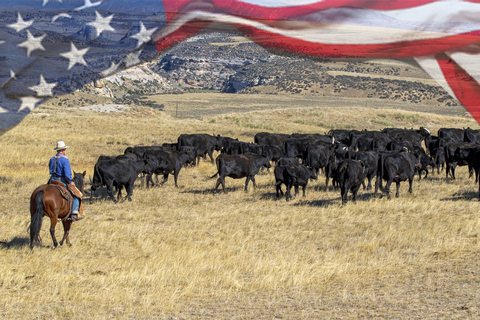
Following weeks of changes to trade and market policies specific to the beef industry, President Trump signed two executive orders on Friday afternoon – one to protect the nation’s cowherd and combat predation and the other to “provide transparency to consumers,” through again exploring country of origin labeling of meat products.
While protecting livestock from predation is likely an issue all ranchers can get behind, revisiting mandatory country of origin labeling (mCOOL) is going to continue to be a mixed bag of opinions across the industry.
The U.S. Department of Agriculture released a statement following the signing of the order calling the administration the most pro-rancher administration in decades.
USDA Secretary Brooke Rollins said the Biden administration villainized ranching and the rural way of life under the guise of radical environmental mandates while the Trump administration is focused on rebuilding the America’s cowherd.
“For the past 19 months, USDA has worked tirelessly to defend and promote our nation’s ranchers. Through our Beef Plan and the Ranchers First Initiative we are working to continue increasing our nation’s heifer retention rate,” Rollins said. “Today, the President laid out tools to better equip farmers and ranchers to deal with dangerous predators threatening their livestock, provide more transparency for consumers on where their meat originates, and expand market opportunities while maintaining our world class food safety standards. President Trump is focused on delivering an America First agenda and will do that by continuing to put our Ranchers First.”
The executive orders come after the administration’s introduction of the broad Ranchers First Initiative that addressed a wide assortment of beef industry policy initiatives aimed largely at growing the national beef herd size. The multi-prong initiative includes plans to address a gamut of regulatory issues that impact beef producers across the beef production chain and make it more difficult for existing ranchers to retain cattle as well as hinder new ranchers from entering the business.
The executive order also comes on the heels of Trump’s unpopular announcement of lowered import tariffs on beef to increase foreign beef imports and reopening of the Mexican border to cattle of Mexican origin over the past year due to the New World screwworm in South America.
While the border opening to Mexican cattle has not faced measurable backlash, ranchers and farm groups strongly oppose the plan to increase ground beef imports, which they argue will disadvantage American producers.
Though some ranchers have sought mCOOL for beef, arguing that would support domestic producers and provide more transparency to consumers. Under current regulations, meat companies can voluntarily add a "Product of USA" label for meat born, raised and slaughtered in the U.S.
Industry groups remain divided on the implications of country of origin labeling with the National Cattlemen’s Beef Association constantly reaffirming the added cost to the American beef producer to implement mandatory labeling.
NCBA has often cited USDA’s estimate on previous mandatory COOL system that imposed $2.6 billion in first-year incremental costs and concluded its economic benefits were difficult to quantify and likely small.
Additionally, NCBA has said the previous beef and pork labeling system resulted in a World Trade Organization dispute in which recordkeeping, segregation and discriminatory effects on imported livestock became central issues. Congress subsequently repealed mandatory COOL on Dec. 18, 2015 for beef and pork products to avoid over $1 billion of retaliatory tariffs on agricultural products.
Today’s news of the executive order sparked a statement from the Meat Institute, which said it appreciates the administration’s focus on strengthening this country’s beef supply chain but does not feel mCOOL is the correct course of action.
"Mandatory COOL is all cost, with no demonstrated increase in demand or added value. USDA’s own Chief Economist reached that conclusion in 2015 after the previous mCOOL program imposed roughly $1.5 billion in implementation costs and $200 million in annual ongoing costs,” the Meat Institute’s statement said.
The Meat Institute says their recent economic analysis shows the same concerns today as in 2015. They say reinstating mCOOL for beef would cost $721 million in first-year implementation costs and add an estimated $835 million annually to consumers’ beef purchases.
“With beef supplies at a 75-year low and demand strong, now is not the time to add unnecessary costs and complexity to the beef supply chain or risk putting further upward pressure on prices. Additional consumer costs could jeopardize the strong beef demand the industry has enjoyed. The U.S. Department of Agriculture has implemented a robust voluntary ‘Product of USA’ label that identifies beef from animals born, raised and processed in the United States. The voluntary label should be given a chance to succeed before Congress repeats a burdensome and costly regulatory mistake.”
Despite the mixed opinions on the president’s recent actions, the Trump administration has rolled out a new website, www.usda.gov/ranchers-first, to highlight their efforts, some of which will undoubtedly be supported by ranchers and others remain questionable.