
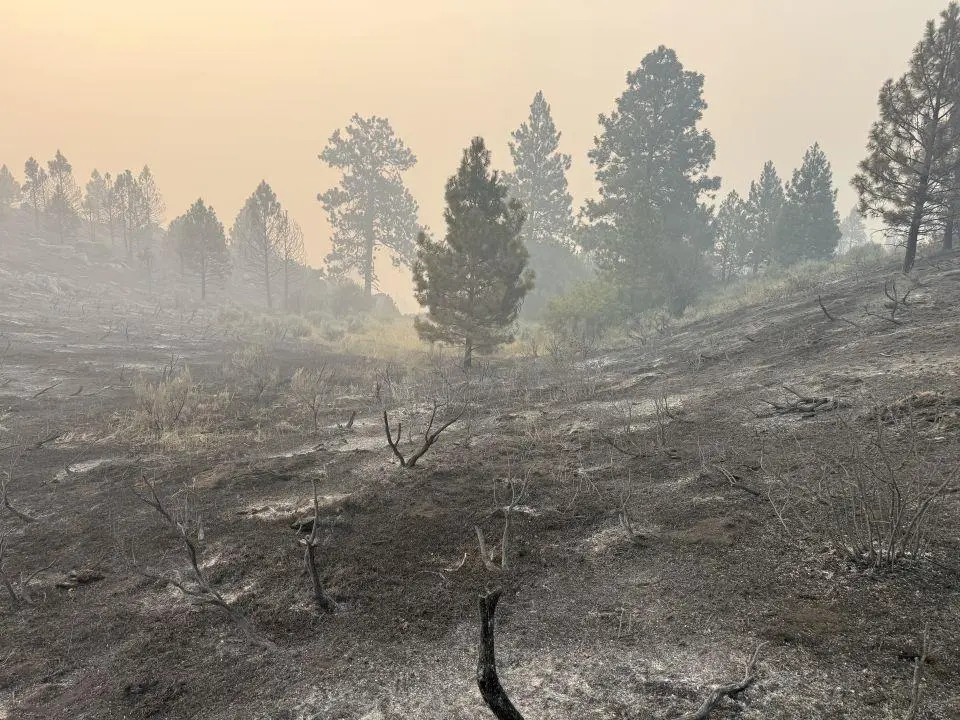
Even as Travis Bloomer guided his horse through the scorched land and the acrid cloying smoke, wondering if he would find the charred carcasses of his family’s cattle, he was gratified by so much that he did see.
Volunteers driving bulldozers in the July heat.
Spraying water on hot spots.
Doing all they could do to protect land, and to save animals, that belong to someone else.
To their neighbors, in many cases.
“This fire, I think, reminded me that one of the great strengths we have in our rural communities is our people,” said Bloomer, who is a partner with his parents, Ted and Diane Bloomer, in a ranch that includes land burned in the Powder River Fire over the past several days.
The Bloomers found all their cattle alive — 70 cow-calf pairs along with some bulls — they had moved to the summer pastures south of Richland just 10 days before the fire started late on July 16.
“People are leaving everything they’re doing to help,” he said. “They’re running toward the smoke when most are running away. I can’t say enough about the volunteer rural fire departments. They are so fast to react and they do all they can to keep fires from getting bigger.”
Waking up to texts about the fire
Bloomer said when he woke up on the morning of July 17, his phone showed multiple texts from people telling him about a new blaze.
The Powder River Fire was reported late on July 16.
The texts told Bloomer that the fire was spreading south over the property his family owns, and adjacent land they lease, for summer grazing.
The Bloomers’ home ranch is in Durkee Valley, about 15 miles southwest, as the raven flies, from where the fire started.
Memories of fire, and its effects, are fresh for the family. The Thompson Fire in July 2024 burned some of their ranch north of Durkee Valley.
Bloomer, who lives in Baker City, said he drove to Richland on Friday morning to assess the situation.
By the night of July 17, he said it looked as though fire crews might have gotten the best of the blaze. But wind, and a heavy crop of tinder-dry cheatgrass and other annual grasses, conspired against firefighters.
On Saturday, July 18, Bloomer, along with his two older sons, Gauge and Dash, along with a friend, Brad Benson, rode horses and four-wheelers into the burn to look for cattle.
(Bloomer and his wife, Tish, both 1995 Baker High School graduates, have three sons — Gauge, Dash and Bruin. Travis said Bruin, the youngest, who will be a freshman at BHS this fall, would have helped but he is recovering after getting a concussion during a wrestling match.)
Bloomer said the situation seemed dire.
The fire burned so intensely that he feared there was no place where cows could shelter. Videos and photos from the day show flames turning trees into torches while cattle run nearby.
Bloomer said his group tried to carve out safe zones, free of grass and fuel, where cattle could potentially escape.
“The hardest thing, for anybody who has cattle, is you want to give them a chance to get away,” he said.
Ultimately, as the dry winds continued to fan the fire, they had to leave temporarily.
“The fire became too intense,” Bloomer said. “We couldn’t breathe, we couldn’t see.”
Bloomer said he tried to remain optimistic. He remembered the 2024 fire, when some of his family’s cattle escaped what seemed to be certain death.
“Cows inherently find a way to survive,” he said. “We learned that in 2024. You open all the gates you can. All you can do is hope for the best.”
When the group returned on Sunday, July 19, they found cattle in places where it seemed nothing could have survived.
Bloomer said perhaps the most amazing episode involved six cow-calf pairs that had huddled beneath an old willow tree in the bottom of a draw. It was the only vegetation that wasn’t charred, and the cattle had instinctively sought out its protection.
“It was almost like a heat shield,” he said. “There was scorched earth all around.”
Although Bloomer was surprised by the cleverness of the cattle, he credits the volunteer firefighters with giving the animals a chance. He said firefighters used bulldozers to scrape firelines that blocked the flames from spreading south toward the Durkee Valley but also served, so far as he can tell, as escape routes for many cattle, including those from other ranches.
Bloomer speculates that some cattle, hearing the rumbling diesel engines, were reminded of the tractors that haul their hay every winter day.
“I think they heard the sound and it drew them,” he said.
He said many of his family’s cattle fled the fire by routes that “they never use.”
“It’s a miracle, honestly,” Bloomer said.
Too much grass
Although drought has dominated discussions for several months, starting with the paltry winter snowpack, Bloomer said this year’s crop of grass, and in particular annual grasses such as cheatgrass, was actually abundant.
Grass that he said is usually a foot or so tall was, this year, a foot and a half.
April was the sole reason.
It was the second-wettest April on record at the Baker City Airport. And Bloomer said the timing of the rain was ideal for annual grasses, which start growing earlier than perennial native grasses such as Idaho fescue and bluebunch wheatgrass.
“The rain came at the perfect time for grass growth, and especially annuals,” he said. “Early season forage was exceptional.”
May and June, by contrast, which on average constitute the wettest period in Baker County, were much drier than usual. And July has brought, with a few brief intervals, hot, dry days.
So one part of the fiery recipe was in place — tens of thousands of acres covered with a potent mixture of sun-dried grass taller than usual, sagebrush and scattered juniper and, at higher elevations, ponderosa pines and some firs.
“The sagebrush is so volatile and quick to burn,” Bloomer said.
Although the 2024 fires burned thousands of acres in the area, the Powder River Fire has mainly scorched ground that didn’t burn two years ago. Had that land burned so recently, there would have been considerably less fuel, and in particular sagebrush and junipers.
The second ingredient, Bloomer said, was timing.
The Powder River Fire started relatively early in the summer — so early that cattle had had little time to gobble grass and so curb the fuel load.
His family’s herd, for instance, had moved onto their range just 10 days before the fire started.
“Two months from now the fine fuels would have been much shorter,” Bloomer said.
Long-term damage
Even if most cattle survive the fire, ranchers’ challenges are just beginning, Bloomer said.
The most pressing problem is to find a place to put the animals.
And, of course, something for them to eat.
The grass that would have fed them through the summer and into fall is now ash.
And with the drought likely to reduce hay yields around the region, hay probably will be more expensive than usual.
The effects aren’t limited to the next few months, either.
Although grass sometimes thrives after a fire, that benefit is delayed — the ground that has burned probably won’t be useful for grazing until 2028.
Many miles of fence will need to be repaired or rebuilt.
“That’s what our neighbors are living with,” Bloomer said. “A lot of people lost a lot more than we have. It’s not over.”
Yet even as he continues to tally the damage, Bloomer said his dismay is partially offset by gratitude for everyone who has strived, and risked their lives, to help.
He noted the many volunteer departments, including Keating, Pine Valley, Eagle Valley, North Powder, and the Lookout Glasgow and Burnt River rangeland fire protection associations.
Bloomer talked about Bert Siddoway, chief of the Burnt River Rangeland Fire Protection Association, the department based near his family’s home ranch in Durkee Valley.
“Bert’s leadership, calm under pressure, and tireless commitment have been invaluable, not just to the fire district but to the entire community,” Bloomer said. “He’s one of those people who quietly makes everything work, and I honestly don’t know where we’d be without him.”
Bloomer said he’s thankful that so many people, some of whom he doesn’t even know, respond so quickly, and work so long, when parts of Baker County are ablaze.
“There are people who are going without sleep,” he said. “I think these wildfires test our community and they reveal our character. That’s why I’m proud to be here.”