
U.S. Cattle Report - Friday, August 7th
Iowa Farm Real Estate Values Top $10,000 Per Acre for the First Time in History 🌽
The USDA released its 2026 Agricultural Land Values report from the National Agricultural Statistics Service (NASS) on Friday afternoon, showing that Iowa's average farm real estate value climbed to a record $10,100 per acre, up from $9,790 per acre in 2025. This marks the first time in history that Iowa's average farm real estate value has exceeded the $10,000-per-acre milestone and sets a new all-time record.
The appreciation in Iowa farmland over the past quarter-century has been remarkable. In 2000, the average farm real estate value was just $1,800 per acre. Since then, values have increased by $8,300 per acre, representing a gain of more than 460% over the last 26 years.
Cattle Futures and Boxed Beef Take Big Hits as Cash Markets Heat Up
Negotiated cash cattle trade was moderate in Kansas, where live sales traded at $235, $2.00 higher than last week. In Nebraska, live trade was steady at mostly $235, while dressed sales were steady at $370 compared to Wednesday. Trade in the Western Corn Belt remained limited, with a few live sales reported from $235 to $236 and a few dressed sales from $375 to $380, though there were not enough transactions for an established market test.
Choice boxed beef declined for the second consecutive trading session on Thursday, falling $4.11 to $363.86. Over the past two trading days, the Choice cutout has declined a combined $5.79. Select boxed beef increased $1.72 to $349.78, narrowing the Choice-Select spread to $14.08. A total of 118 loads were reported. The decline in Choice was led by the rib, which dropped $28.91 to $570.99. Other primals were mixed compared to Wednesday, with the round down $1.84 to $309.96, the loin down $1.26 to $440.27, the brisket down $0.14 to $338.68, the plate down $1.17 to $261.11, and the flank down $6.24 to $210.07. The chuck was the only primal to post an increase, edging $0.57 higher to $316.14.
Federally inspected cattle slaughter totaled 107,000 head on Thursday, up from 102,000 head a week ago but below 116,752 head on the same day last year. Week-to-date cattle slaughter reached 413,000 head, compared to 407,000 head a week ago and 449,284 head during the same period a year ago. Year-to-date, federally inspected cattle slaughter stands at 16,271,826 head, down 8.2% from 17,730,871 head at this point last year.
Live cattle futures closed lower Thursday, with the August 2026 contract settling at $231.225, down $2.950. Feeder cattle futures also moved lower, as the August 2026 contract closed at $348.050, down $5.275. In the outside markets, September 2026 corn settled at $4.39/bu, up 2.25 cents, while September crude oil closed at $78.15, up $2.93. The Dow Jones Industrial Average ended the session at 53,885.10, down 464.02 points (-0.85%)
The Beef Cow Herd Continues to Get Older ⏳
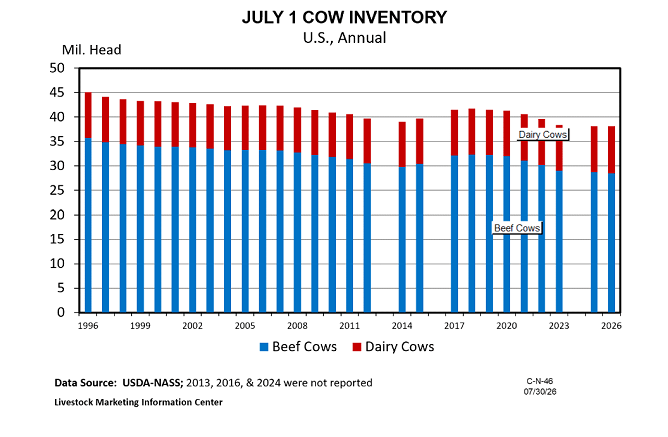
According to Dr. Kenny Burdine, University of Kentucky, the U.S. beef cow herd continues to age as producers retain cows longer while very few young females enter the breeding herd. Beef cow slaughter declined more than 500,000 head (17.6%) in 2025 and is on pace to fall by another 350,000 head in 2026, resulting in historically low culling rates. Despite fewer cows being culled, the overall herd continues to shrink, signaling that replacement heifer retention remains limited.
Dr. Burdine notes that an aging cowherd will eventually require a larger share of cows to be culled, reinforcing the expectation that herd rebuilding will be gradual. He views the combination of low herd entry, declining cow numbers, and an older breeding herd as another indication that any expansion of the U.S. beef cow herd is likely to be slow.
Teamsters Reject Latest Cargill Offer, Fort Morgan Lockout Continues
According to the Fort Morgan Times, members of Teamsters Local 455 voted on Monday, Aug. 3, to reject Cargill's latest contract offer, extending the labor dispute at the company's Fort Morgan, Colorado, beef processing plant. Union officials said members believed the proposal did not provide a significant enough improvement over the offer presented in May. Following the vote, the union informed Cargill of the decision and asked whether the company was willing to continue negotiations or modify its proposal. According to the report, the company acknowledged the vote but did not indicate it would resume bargaining.
The lockout began on May 20 after union members rejected a previous labor agreement over concerns related to wages, health care, and workplace safety. The union maintains that employees were locked out rather than going on strike and says picketing will continue while it seeks to bring the company back to the negotiating table. Approximately 1,700 employees are affected by the dispute, with the union continuing to provide weekly financial assistance to members during the ongoing lockout.